

Hernia Repair
in Houston, TX
Our Mission Statement
My goal is to provide the most effective treatments of Hernias that involve that abdominal wall and the groin with Minimally Invasive Surgery (small and not large incisions) to provide for:

- Best outcomes
- Least discomfort
- Best Cosmetic outcomes
- Minimal use of Narcotics
- Early return to work and full function
- Only use the best meshes which lead to better outcomes
We use the new Phasix™ Mesh which disappears after a period of time and lets the patient’s body heal itself
The most up to date advancement in surgery now use the Davinci Robotic instruments which are the latest improvements in Minimally Invasive Surgery. When compared to the standard Laparoscopic Surgical techniques, my patients receive a better technical operation and have less discomfort. When the Davinci is compared with the standard Laparoscopic Groin hernias are now treated with The Davinci Robot and no longer require the use of painful tacks (tiny screws) that can cause short and long-time chronic pain.
The Davinci now makes it possible to treat large and complicated hernias that typically could only be performed with large painful incisions. Even patients with large complicated hernias usually go home within 24 hours after the procedure instead of 5-7 days. Most of my patients return to work (light duty) after 1 week. Many have even returned to work on the following Monday after an operation performed on Thursday or Friday.
What is a Hernia?
A hernia is a weakness or tears in the abdominal muscles that allow fatty tissue or an organ such as the intestines to protrude through the muscle tissue. Hernias most often occur in or around the groin, abdomen, and navel or near previous sites of abdominal surgery. Studies have shown that 30% of all patients who undergo an abdominal operation will develop a hernia. This includes Gallbladder, Gastric weight loss operations, prior laparoscopic in Inguinal Hernia repairs, and Cesarean operations.
A hernia will generally increase in size and become more painful if left untreated, and can also lead to more serious, life-threatening complications.
The National Center for Health Statistics estimates that about 5 million people in the U.S. have an abdominal hernia. Hernia repair is one of the most common surgical procedures performed in the U.S. More than 750,000 people seek treatment for hernias each year.
Treatment Options For a Hernia Include:
Traditional Hernia Repair Surgery
Traditional hernia repair surgery involves making an incision in the abdomen, pushing back any protruding tissue, and then stitching the tissue together to close the incision. Recovery time usually lasts about 4-6 weeks, and there is a 15-30 percent chance that the hernia will recur.
Non-Tension Hernia Repair
Non-Tension Repair involves using a synthetic mesh device that is sutured on top of the hernia repair.
Laparoscopic Hernia Repair
With Laparoscopic Repair, a small fiber-optic viewing tube is used to examine the hernia, close the hernia hole with sutures or tacks and place a mesh patch on the inside of the abdominal wall where pressure from within the abdominal cavity helps to hold the mesh in place. The mesh acts to support the closure of the repair to reduce the chances that the hernia will recur.
This technique has been extensively studied and has the highest success rate of any of the prior techniques. The recurrence rate has been shown to be 2 in 100 cases for Non-Tension repairs instead of 6-8 in 100 patients as is seen in tension repairs.
Shouldice Inguinal hernia repair
Another tried and proven technique in selected cases is called the Shouldice Inguinal Hernia Repair. This technique involves the meticulous repair of the Inguinal floor and NO MESH is used. The Houston Robotic Hernia Surgery is one of a few centers in the USA that performs this procedure.
Robotic Laparoscopic Hernia Repair
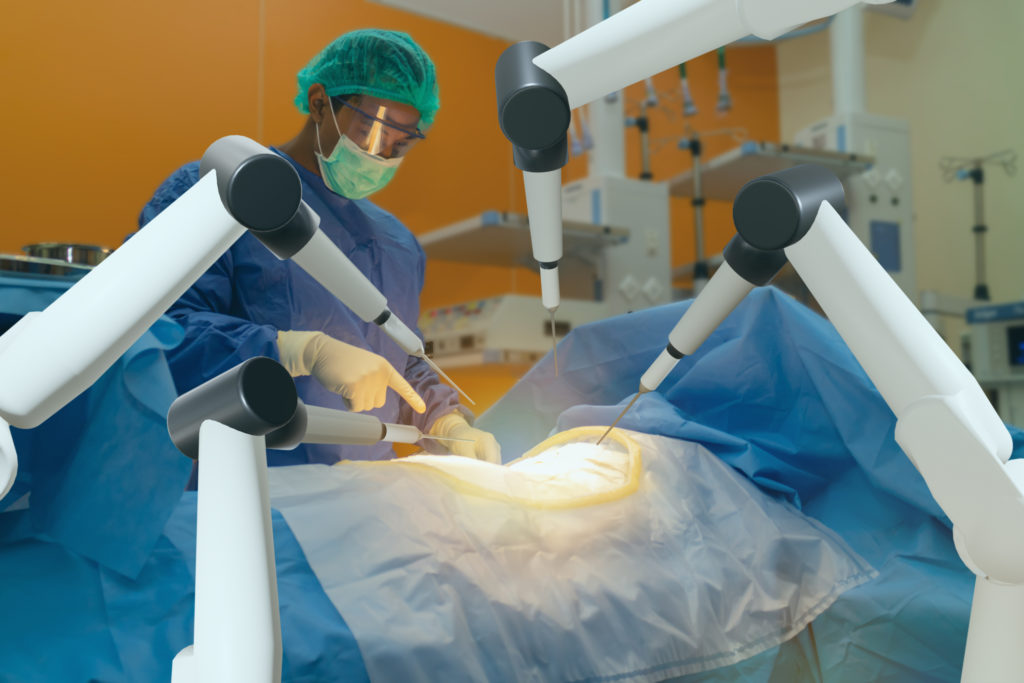 The latest improvements in surgery have been advanced by the use of Davinci Robotic Laparoscopic Repair. This is a system in which the surgeon inserts a Laparoscope to view the inside of the abdominal wall. Once the instruments are inserted, the surgeon sits at a console with Magnified Stereoscopic Vision. With his fingers, the surgeon guides the robot to perform simple and complex procedures that cannot be performed with a Laparoscope. Sewing, cutting, and tying sutures and tissue are more precise. Very precise sutures are used instead of tacks (tiny screws).
With the Davinci Robot, I can now repair large abdominal wall hernias. I have found that patients recover quicker and with less pain when compared with an open or Laparoscopic operation. Whenever possible, I prefer to operate with the Davinci Robotic System.
“With newer treatment options we can now repair a hernia using an outpatient procedure that is generally faster and less invasive than traditional surgical procedures,” explains Dr. Kim. “Following treatment, hernia patients can now return home the same day and resume many normal activities in a matter of days.”
Post-Operative Hernia Repair Pain Control
I also focus on post-surgery pain control by using the latest in non-narcotic medications. The majority of my patients do not require narcotics after the operation. Narcotics are addicting and can cause severe constipation which prolongs the patient’s recovery.
All of my patients are placed on 2 tablets of Tylenol the night before the operation and 2 tablets the morning of the operation with a sip of water. Do not take Aspirin or Non-steroidal medications because the cause bleeding. If the patient takes these medications, they will wake up with minimal pain and discomfort. If they don’t take these medications, they will wake up with severe pain. Pre-operative pain control is extremely important.
Most of my patients receive a new pain controlling medication during the operation. As you know, a commonly used pain-numbing medication is called Xylocaine. Xylocaine works well for 1-2 hours but then the pain recurs. Studies have shown that early control of pain that last for longer periods of time improve recovery and early return to a good quality of life. I now use a new medication called “Xparel”. The mediation is given at the START of the operation and the last 4 DAYS. This will avoid the severe early postoperative pain. Early control of pain is extremely important.
After the operation, my patients are instructed to take 2 tablets of Tylenol and 2 tablets of Ibuprophen (TOGETHER) every 6 hours. If the patient follows this plan, they will rarely need to take NARCOTICS. Most of my patients take little or no postoperative Narcotics.
Schedule a Consultation Today
If you’re interested in learning more about hernia repair please contact us for a consultation at (713)932-1001 or 713-464-2100 Option 2 or fill out our contact us form. We will discuss your needs and concerns, and determine your best course of action.